

Until recently the emissions question reached us once a year, from a sustainability team, in a spreadsheet nobody enjoyed filling in. It now reaches us from procurement, at the point of booking, with a deadline attached. That is a different question and it deserves a straight answer.
Business travel sits in Scope 3, Category 6. Under the Corporate Sustainability Reporting Directive and ESRS E1, companies in scope have to disclose it — broadly, those above one thousand employees and roughly €450 million of turnover. Flights are the large number. Ground transport is the small one, and it is also the one nobody can evidence.
Why the ground leg is the data gap
A flight leaves a clean trail: a ticket, a booking class, a great-circle distance. A transfer often leaves nothing but a card receipt. There is no vehicle recorded, no distance, no fuel type — a line of expense that could equally have been a diesel estate or an electric saloon. When the reporting deadline arrives, that line gets filled with a generic factor, and a generic factor is the most punitive number available.
This is worth saying plainly. The reporting problem with ground transport is that it goes undocumented, which is a different complaint from saying it is dirty.
Switzerland is not in scope. Your invoice still is.
We are a Swiss company, so the CSRD binds our clients rather than us. That distinction matters less than it sounds, because the obligation travels down the invoice: a reporting entity needs route-level data from its suppliers whether or not those suppliers are themselves reporting. A supplier who cannot say which vehicle drove which distance leaves a gap in your report, and a gap has to be filled with an estimate.
The electric car is priced as a Business car
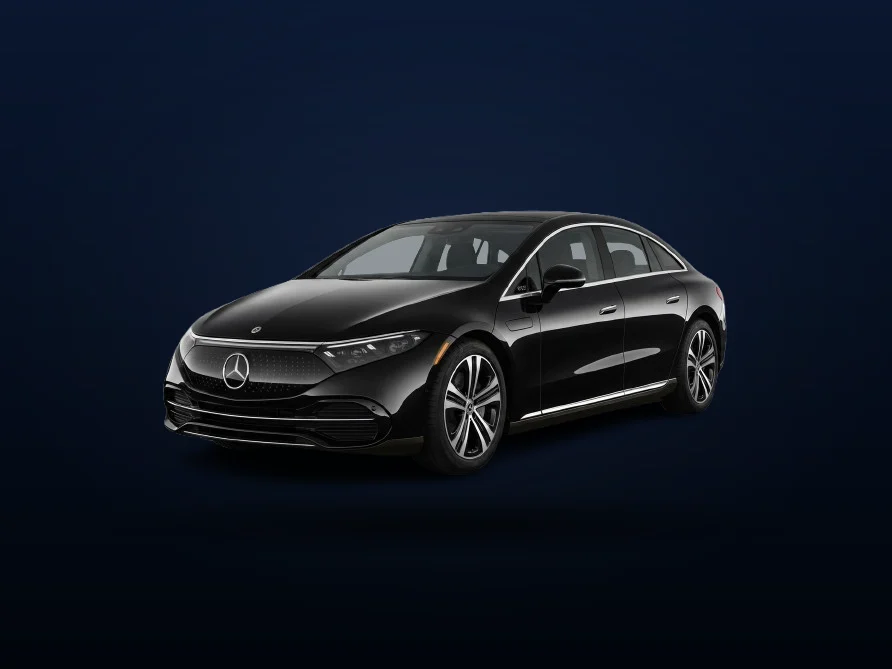
We run a fully electric saloon as a bookable class, and it is charged at the Business rate — CHF 6.00 per kilometre, minimum fare CHF 120.00, the same as the E-Class. Not a premium, not a surcharge, not a green tariff.
That is a deliberate commercial decision rather than a gesture. The moment the low-emission option costs more than the default, it stops being a policy and becomes a request for a budget exception, and requests for budget exceptions do not get made at 06:00 by someone booking a car to the airport. Price parity is what makes a travel policy enforceable.
Range is planned before the car is assigned
The honest limitation of an electric transfer is the long leg. St. Moritz is 215 kilometres from the airport and takes just under three hours; Milano is 280; Bolzano is 320. Those are not journeys to improvise a charging stop into with a client in the back.
So range is planned against your specific route before the car is assigned. If the route does not work on the charge, we say so at quote stage and send a combustion car instead of discovering the problem on the Julier. A charging stop you did not agree to is a service failure, not an environmental credential.
What to ask a ground supplier
- Can you give me distance and vehicle class per journey, on the invoice?
- Is the low-emission vehicle priced at parity, or at a premium?
- Is it a bookable class, or one car you hope is free?
- Who decides whether the route is viable on a charge, and when?
- Will the same data reach me monthly, per cost centre, without my asking?
The car that meets you is a small line in a large report, and one of the few where the cleaner choice costs nothing. Claiming it takes a vehicle class on the booking, a kilometre figure on the invoice, and someone at the supplier who can produce both twelve months later. We keep that record per journey, per cost centre, and send it monthly.